
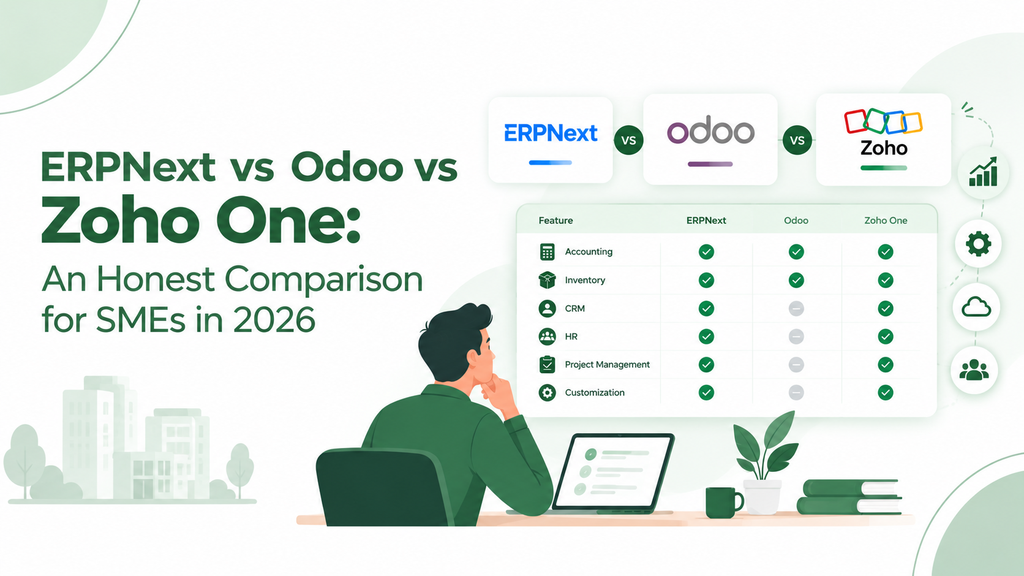
ERPNext vs Odoo vs Zoho One: An Honest Comparison for SMEs in 2026
Most ERP comparisons are written by someone selling one of the three. So is this one. We are an official Frappe Partner, and we implement ERPNext every week.
That is exactly why we want to be honest. A client who picks the wrong ERP because a partner oversold it becomes a failed project, a bad review and a lost referral. So this guide tells you where ERPNext wins, where Odoo wins, where Zoho One wins, and the questions that should decide it for your business.
1. Cost: the number that changes after year one
Licence cost is where the three are most different, and where most buyers do the maths wrong. They compare the first-year quote instead of the five-year total.
ERPNext
The software licence is free under GPL v3. You pay for hosting and for the partner who implements it. Frappe Cloud, the official host, bills by server capacity, not by user, so adding your 20th or 50th user does not raise your licence bill.
Odoo
Odoo Community is free but leaves out several features businesses expect, such as the full accounting app. Most companies end up on Enterprise, which is priced per user per month. In September 2026 Odoo raised its Custom plan prices in several regions; in India the yearly-billed rate went up by about 21%.
Zoho One
Zoho One is subscription-only and priced per user. Its lower "All Employees" price requires you to license every employee on the payroll, so it gets expensive as headcount grows even if only a few people use the software every day.
2. Flexibility: what happens when your process is "different"
Every business says its process is unique. Usually 80% of it is standard, and 20% is genuinely yours: a commission rule, a dealer price list, a custom approval chain, a GOSI or WPS file format.
- ERPNext gives you the full source code and the Frappe framework underneath it. Custom fields, workflows, reports and entire new apps can be built without forking the core, so upgrades stay manageable.
- Odoo is very customisable too, especially with Odoo.sh. The catch is that Enterprise modules are licensed code, and heavy changes can make version upgrades expensive.
- Zoho One customises well inside its own tools (Creator, Deluge scripts, Blueprint). When you hit the edge of what Zoho allows, there is no source code to fall back on.
3. Compliance for India and the GCC
For our clients, this is often the deciding factor.
- India: ERPNext has GST support through India Compliance, an open-source Frappe app covering e-invoicing and e-way bills. Odoo and Zoho Books both have GST-ready localisation as well.
- Saudi Arabia: ZATCA e-invoicing (Fatoora) Phase 2 needs integration with the ZATCA platform. ERPNext supports it through community and partner apps; Odoo and Zoho also offer ZATCA-compliant invoicing. Check the integration status for your wave before you sign anything.
- UAE: VAT is well covered by all three. With the UAE's e-invoicing programme on the way, ask every vendor how they plan to support it.
4. Manufacturing and inventory depth
If you make things, this section matters most.
ERPNext ships multi-level Bills of Materials, work orders, job cards, production planning and quality inspection in the standard product. Odoo's MRP app is equally deep and has a polished shop-floor interface. Zoho One is strongest in inventory and order management; for multi-level manufacturing, most Zoho users add a third-party app or a separate system.
5. Support and ecosystem
- ERPNext: Frappe plus a global partner network. Quality depends heavily on your partner, so check their real client references.
- Odoo: The largest partner network of the three, and the same rule applies.
- Zoho One: Zoho's own support plus regional partners. One vendor relationship is simpler, but it also means one vendor controls your roadmap
So which one should you choose?
Choose ERPNext if:
- You want to own your system and your data, with no per-user licence lock-in.
- You expect headcount to grow and don't want the bill to grow with it.
- You need custom workflows, Saudi HR rules or industry-specific features.
Choose Odoo if:
- You want the widest app catalogue with a consistent, polished interface.
- Your budget comfortably covers per-user Enterprise licences.
Choose Zoho One if:
- Your business runs mainly on CRM, email, marketing and simple invoicing.
- You prefer one subscription and don't need deep manufacturing.
Frequently asked questions
Is ERPNext really free?
Yes. The licence is free and open source. You still pay for hosting (cloud or your own server) and for implementation, training and support if you use a partner.
Can I migrate from Zoho or Odoo to ERPNext?
Yes. Masters (customers, suppliers, items), opening balances and open transactions can be migrated with ERPNext's data import tools. Plan for a clean cut-over at a month-end or year-end.
Which ERP is best for a small business in India?
For SMEs with fewer than 50 users that need accounting, GST, inventory and some customisation, ERPNext usually has the lowest five-year cost. If you only need invoicing and CRM, a lighter tool may be enough.
Is ERPNext good for UAE and Saudi companies?
Yes. It supports multi-currency, Arabic, VAT and payroll. Saudi-specific needs such as GOSI, WPS and ZATCA are handled with Frappe apps or partner customisation
Get an honest second opinion
Still comparing quotes? Send us your shortlist and your user count, and we'll give you a five-year cost comparison across all three. That includes telling you if ERPNext is not the right fit.
[Book a free 30-minute ERP consultation](https://labofweb.com/contact) with LABOFWEB, an official Frappe Partner serving SMEs in India and the GCC.
Ready to Elevate Your Digital Operations?
Whether you need custom ERP solutions, web & mobile applications, or sustainability management, our expert team is here to help you scale efficiently.